
 Let's Record Your Thoughts
- AI voice Dataset Projects Demand in 2026
- 1. The “Diversity Debt”: Bridging the Linguistic Gap
- 2. IndicVoices and the Rise of Regional Data
- 3. Why Professional Recording Studios are Essential for AI voice Dataset
- 4. The Mimicry Factor: Teaching AI Emotion and Nuance
- 5. Economic Opportunities for the Indian Talent Pool
- 6. The Technical Hurdle: Clean Data vs. Real-World Noise
- 7. The Ethical Frontier: Privacy and Consent
- Conclusion: The Future is Vocal
AI voice Dataset Projects Demand in 2026
The landscape of Artificial Intelligence is undergoing a massive shift. A few years ago, AI sounded robotic, monotone, and predominantly Western. Today, the race is on to make AI sound human, empathetic, and—most importantly—local. For a country as linguistically diverse as India, this shift has sparked an unprecedented demand for high-quality Indian voice datasets for voice over artist.
If you are in the voice-over industry or the tech space, you are standing at the intersection of a multibillion-dollar opportunity. Here is a deep dive into why Indian voices are the most sought-after assets in the AI world today.
1. The “Diversity Debt”: Bridging the Linguistic Gap
For decades, voice technology was built on “High-Resource Languages” like English, Spanish, and Mandarin. While these models worked well globally, they struggled in the Indian subcontinent. India doesn’t just speak one language; it speaks in hundreds of dialects, accents, and “code-switching” styles (like Hinglish or Tanglish).
AI voice Dataset projects are now focused on clearing this “diversity debt.” Tech giants and startups alike are realizing that to capture the Indian market, their AI voice dataset must understand a grandmother in rural Bihar just as well as a tech professional in Bangalore. This requires massive amounts of “Clean Data”—voice recordings that are clear, transcribed, and representative of real-world speech.
2. IndicVoices and the Rise of Regional Data
One of the most ambitious projects currently making waves is IndicVoices. This initiative aims to document the 22 constitutionally recognized languages of India, covering thousands of hours of speech. But the demand goes beyond just “official” languages.
There is a growing hunger for:
- Rural Dialects: To help farmers access AI-driven agricultural advice.
- Tier-2 and Tier-3 Accents: To make e-commerce voice assistants more relatable.
- Conversational Speech: Moving away from “reading a script” to natural, extempore talking that includes stutters, pauses, and emotional nuances.
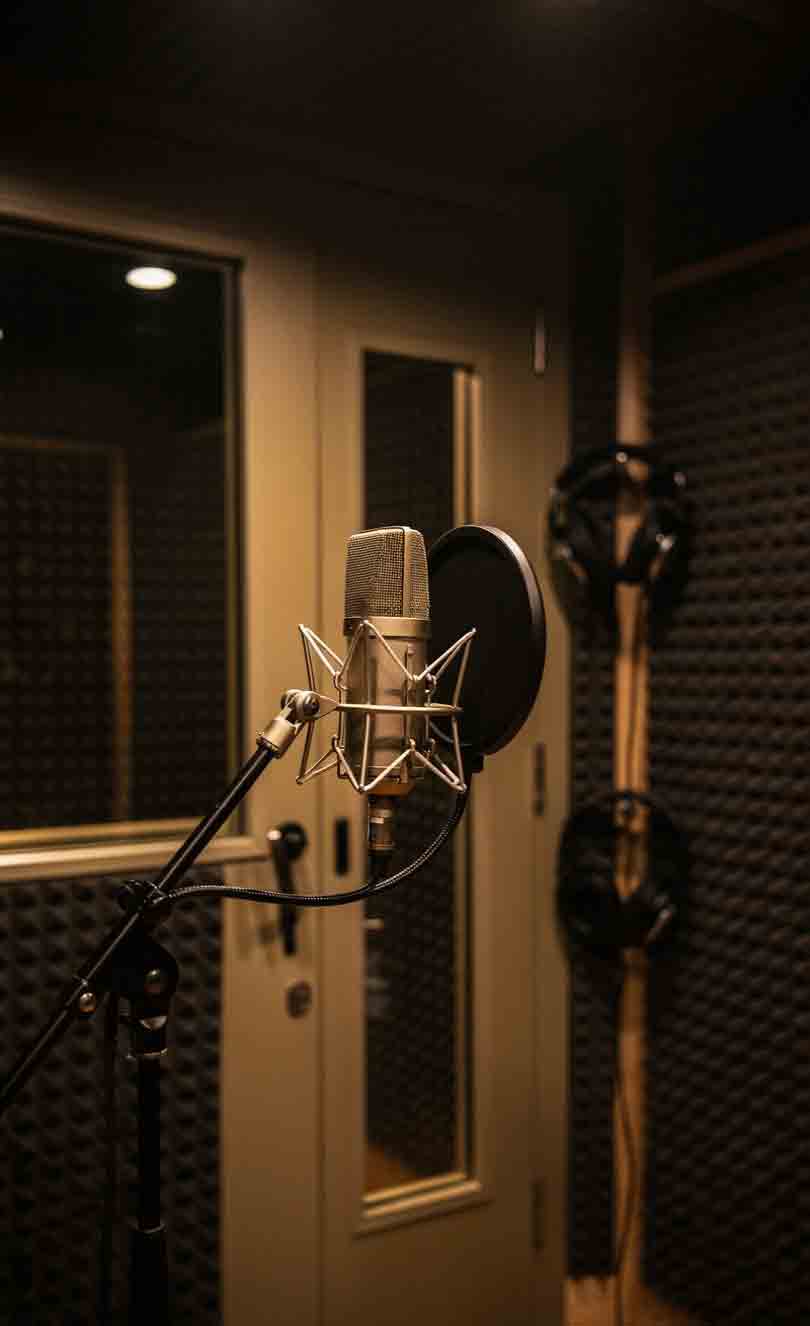
3. Why Professional Recording Studios are Essential for AI voice Dataset
In the early days of AI, “scraped” data from the internet was enough. However, as AI moves toward High-Fidelity Text-to-Speech (TTS) and Voice Cloning, the quality of the recording environment has become the most critical factor.
This is where professional recording studios come into play. AI companies need:
- Acoustically Treated Spaces: To ensure there is zero background noise or echo.
- High-End Microphones: To capture the full frequency range of the human voice.
- Consistency: Recordings done over several days must have the exact same tonal quality to train a stable AI model.
For a studio, being “AI-ready” means providing the pristine environment that algorithms need to learn the subtle textures of human breath and resonance.
4. The Mimicry Factor: Teaching AI Emotion and Nuance
One of the most fascinating frontiers in AI voice dataset collection is the study of Prosody—the rhythm, stress, and intonation of speech. AI is no longer satisfied with just “words”; it wants to learn style.
This has led to a demand for voice artists who can perform:
- Bollywood-style Mimicry: Teaching AI to understand humor, satire, and iconic tonal shifts.
- Character Voices: Helping AI assistants sound like a friendly “Dada” or a helpful “Behenji.”
- Emotional Range: Providing datasets that range from “strictly professional” to “excitedly helpful” or “deeply empathetic.”
The more AI voice dataset can capture the “soul” of a performance, the more valuable it becomes to developers building the next generation of virtual companions.
5. Economic Opportunities for the Indian Talent Pool
The demand for Indian voices is creating a brand-new economy for voice-over professionals and studio owners. We are seeing a shift from traditional “one-off” ad dubbing to long-term Data Contribution contracts.
- Voice Licensing: Artists are now licensing their “voice prints” for AI models.
- Bulk Transcription Services: Creating a massive need for native speakers to verify and tag audio data.
- Studio Hot-Desking: Studios are becoming hubs for AI companies to fly in speakers from across the country to record in a controlled environment.
6. The Technical Hurdle: Clean Data vs. Real-World Noise
While studios provide “clean” data, AI voice dataset also needs to be “stress-tested.” This is why many projects now collect Parallel Datasets. They record a professional voice in a studio and then record the same voice in a simulated “noisy” environment (like a busy Delhi street or a rainy day).
This helps the AI learn how to “noise-cancel” and focus on the human element, making voice-activated technology (like robotic petrol pumps or automated parking systems) functional in the chaotic real-world environments of India.
7. The Ethical Frontier: Privacy and Consent
As we move forward, the “Demand for Voices” must be balanced with “Protection of Identity.” The most successful AI voice dataset projects in 2026 are those that prioritize Ethical AI voice. This means:
- Clear Consent: Ensuring voice artists know exactly how their data will be used.
- Fair Compensation: Recognizing that a voice is a lifelong asset.
- Watermarking: Using technology like SynthID to ensure AI-generated voices can be identified, preventing deepfakes.
Conclusion: The Future is Vocal
India is no longer just a consumer of AI; it is the engine room of its linguistic development. From the streets of Chennai to the studios of Janakpuri,New Delhi, the sound of the Indian voice is being digitized to build a more inclusive future.
For creators, studio owners, and linguists, the message is clear: Your voice is your most valuable asset. As AI continues to evolve, those who can provide high-quality, culturally rich, and demographically diverse voice data will be the ones who define how the world hears India.
Key Takeaways for Your Readers:
- AI Needs Quality: Low-quality recordings lead to failing models.
- Regional is King: The biggest growth is in non-English Indian languages.
- Studios are Crucial: Professional environments are the backbone of high-fidelity AI.
- Ethical Sourcing: Always prioritize artist consent in dataset projects.
- Latest bollywood News: Box Office Analysis, Mega projects, and Star Updates (2026 Edition)

- Dhurandhar 2: A Global Blockbuster Hits a Speed Bump in Japan
- The Hidden Legal and Reputational Risks of AI Voices: What Content Creators Need to Know
- Why Indian AI voice Dataset Projects are the New Digital Gold ?
- Shah Rukh Khan in Jawan 2: The Evolution of Voice, Age, and Authority
- Latest Bollywood News: Star Updates, Releases & Gossip Unveiled!
- Dhurandhar 2 Review : Cast, Dubbing Secrets & Voice Performance Breakdown (2026)
- After Sunil Grover, Sandeep Salwann Emerges as a Remarkably Accurate Aamir Khan Mimicry
- Ranbir Kapoor vs Ranveer Singh: Who Has the Better Voice?









Leave a Reply